Although the new U.S. health care law does not specifically alter the current fee-for-service payment structure, changes to how physicians and hospitals will be reimbursed for services are under construction. These changes are reflected by the growing focus on the development and implementation of quality improvement and physician and institutional performance measures on which reimbursement will increasingly be made, panelists said here on Sept. 11 at the 2011 American Academy of Otolaryngology-Head and Neck Surgery (AAO-HNS) Annual Meeting.
A Blessing and a Curse: Health care reform comes at a steep price
There is a Chinese proverb that is both a blessing and a curse. The blessing is, “May you live in interesting times,” and the curse is, “May you live in interesting times.” All of us would like things to stabilize into a constant, comfortable and predictable environment for us to live our lives, raise our families and care for our patients. We are entering the most complex and challenging period that medicine has experienced since the 1960s when Medicare was introduced. From now on, everything we have come to know and are comfortable with in our professional lives will change.
New Speech-Language Pathology Rule: Supervision of videostroboscopy and nasopharyngoscopy no longer required
Medicare requirements for physician supervision of speech-language pathologists conducting videostroboscopy (CPT 31579) and nasopharyngoscopy (CPT 92511) will move from the strictest level of oversight back to no national supervision level starting in October.
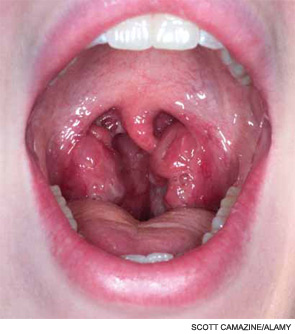
Sleep Studies Clarified: New guidelines amplify the role of PSG for children with sleep-disordered breathing
For otolaryngologists seeing increasing numbers of children with sleep-disordered breathing, whether or not to refer children for a polysomnography (PSG) prior to surgery is not a decision easily made. Currently, only about 10 percent of otolaryngologists request a sleep study in children with sleep-disordered breathing prior to surgery.
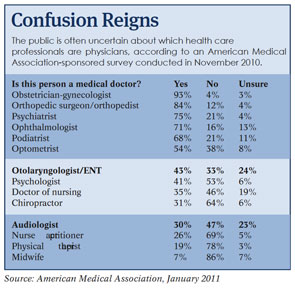
Identity Crisis: A new bill would require marketing materials to clarify one’s credentials
More often than not, members of the public are confused about which health care providers are physicians and which are not. That uncertainty is expected to increase as the trend toward non-physician providers earning doctorate degrees continues and as demand for services grows with the millions of people gaining insurance under the 2010 health reform law.
Health Reform Hits Sleep: Speakers encourage specialists to get involved in initiatives
As in all of medicine, the future of sleep medicine will be defined in part by changes evolving under the health care reform law and by the need to slow the unsustainable cost of medical care, experts said here last month at a session at SLEEP 2011, the 25th Annual Meeting of the Associated Professional Sleep Societies,
British Surgeon Describes Lessons Learned from Trainee Duty Hour Limits
Lord Ribeiro gave his presentation at COSM 2011.
TRIO President Discusses the Benefits of U.S. Scientific Research
Dr. Gerald Berke gave his presentation at COSM 2011.
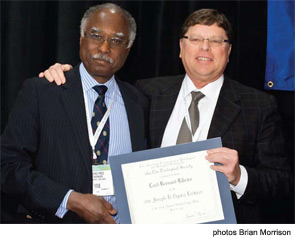
Training Trends: British surgeon offers cautionary tale about limit on trainee duty hours
New limits on doctors in training in the United Kingdom (U.K.) have drastically reduced the amount of training they receive and may put patients in peril, a renowned retired British surgeon told listeners here on April 29 at the Annual Meeting of the Triological Society, held as part of the Combined Otolaryngology Spring Meetings.

Trio Transitions: The outgoing and incoming presidents share their goals for the society
At the Triological Society’s Annual Meeting in April, Robert H. Ossoff, DMD, MD, Maness Professor of Laryngology and Voice and assistant vice-chancellor for compliance and corporate integrity at Vanderbilt University Medical Center in Nashville, will assume the presidency of the society. Dr. Ossoff will be filling the role currently held by Gerald Berke, MD, chief of head and neck surgery at the University of California, Los Angeles.
- « Previous Page
- 1
- 2
- 3
- 4
- 5
- 6
- …
- 15
- Next Page »