• Home
  • Practice Focus
    • Facial Plastic/Reconstructive
    • Head and Neck
    • Laryngology
    • Otology/Neurotology
    • Pediatric
    • Rhinology
    • Sleep Medicine
    • How I Do It
    • TRIO Best Practices
  • Business of Medicine
    • Health Policy
    • Legal Matters
    • Practice Management
    • Tech Talk
    • AI
  • Literature Reviews
    • Facial Plastic/Reconstructive
    • Head and Neck
    • Laryngology
    • Otology/Neurotology
    • Pediatric
    • Rhinology
    • Sleep Medicine
  • Career
    • Medical Education
    • Professional Development
    • Resident Focus
  • ENT Perspectives
    • ENT Expressions
    • Everyday Ethics
    • From TRIO
    • The Great Debate
    • Letter From the Editor
    • Rx: Wellness
    • The Voice
    • Viewpoint
  • TRIO Resources
    • Triological Society
    • The Laryngoscope
    • Laryngoscope Investigative Otolaryngology
    • TRIO Combined Sections Meetings
    • COSM
    • Related Otolaryngology Events
  • Search

Pediatric Ear Infections: Watchful Waiting May Be the Best Strategy

by Sheri Polley • November 1, 2006

  • Tweet
  • Click to email a link to a friend (Opens in new window) Email
Print-Friendly Version

There are few things more frustrating and upsetting for parents than watching their child suffer from the pain and discomfort of an ear infection. In the short term, the parents’ primary objective is typically to obtain some relief for their child. Many parents have concerns regarding the long-term effects from chronic or recurrent ear infections, however, based on the traditional belief that the child’s cognitive and functional skills could be irreversibly damaged by hearing loss caused by fluid lingering in the middle ear. Recent studies have indicated not only that the risk for these long-term effects be may much lower than previously believed, but also that more conservative treatment of ear infections in the short term may be effective.

You Might Also Like

  • Watchful Waiting and OME
  • Meningitis Vaccine Leads to Greater Reduction in Ear Infections
  • Pediatric Infections Cluster by Age
  • Newly Formed Society for Middle Ear Disease Aims to Educate, Advocate
Explore This Issue
November 2006
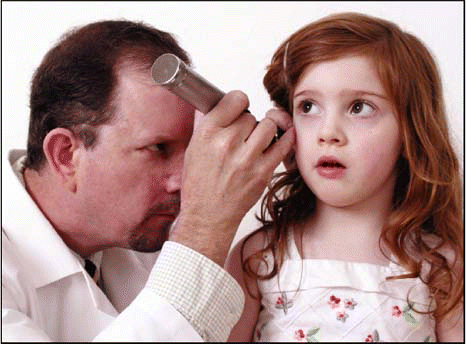
Figure. Otolaryngologists have the ability to correctly diagnose hearing problems and prescribe the proper devices to correct them.

click for large version
Figure. Otolaryngologists have the ability to correctly diagnose hearing problems and prescribe the proper devices to correct them.

Long-Term Effects of Otitis Media

According to a study published in Pediatrics, “Otitis Media in Early Childhood in Relation to Children’s School-Age Language and Academic Skills” (Pediatrics 2002;110:696–706), a child’s home environment is more predictive of language and academic outcomes than is a history of otitis media with effusion (OME) or hearing loss. The study found no significant relationship between a history of OME and children’s academic skills in reading or word recognition in early elementary school. Children suffering from a greater incidence of OME and hearing loss did score lower in math and expressive language skills at younger ages, but caught up with their peers by the time they reached second grade.

Joanne Roberts, PhD, Senior Scientist at the Frank Porter Graham Child Development Center at the University of North Carolina at Chapel Hill, and primary author of the Pediatrics study, stated, “Our research is finding little support for a history of chronic ear infections and associated hearing loss causing later difficulties. These data certainly do support a more conservative approach.”

With the level of risk for long-term effects called into question, a controversy now exists regarding whether traditional treatment of pediatric ear infections has been too aggressive, and whether, perhaps, the treatment itself is responsible for undesirable long-term effects.

‘Wait-and-See’ Approach to Antibiotic Usage

Physicians write approximately 15 million prescriptions annually in the United States for antibiotics to treat acute otitis media (AOM), at an estimated cost of $10 to $100 per course of therapy. The risks of antibiotics—including gastrointestinal upset, allergic reactions, and accelerated antibacterial resistance—have many researchers questioning whether the benefits of such widespread antibiotic therapy justify these risks.

Pages: 1 2 3 4 5 | Single Page

Filed Under: Departments, Medical Education, Otology/Neurotology, Pediatric, Practice Focus Tagged With: antibiotics, diagnosis, otitis media, outcomes, pediatrics, research, sensorineural hearing loss, techniques, treatmentIssue: November 2006

You Might Also Like:

  • Watchful Waiting and OME
  • Meningitis Vaccine Leads to Greater Reduction in Ear Infections
  • Pediatric Infections Cluster by Age
  • Newly Formed Society for Middle Ear Disease Aims to Educate, Advocate

Leave a Reply Cancel reply

Your email address will not be published. Required fields are marked *

The Triological SocietyENTtoday is a publication of The Triological Society.

Polls

Do you use TXA to reduce intraoperative and post-op bleeding?

View Results

Loading ... Loading ...
  • Polls Archive

Top Articles for Residents

  • A Resident’s View of AI in Otolaryngology
  • Call for Resident Bowl Questions
  • Resident Pearls: Pediatric Otolaryngologists Share Tips for Safer, Smarter Tonsillectomies
  • A Letter to My Younger Self: Making Deliberate Changes Can Help Improve the Sense of Belonging
  • ENTtoday Welcomes Resident Editorial Board Members
  • Popular this Week
  • Most Popular
  • Most Recent
    • Office Laryngoscopy Is Not Aerosol Generating When Evaluated by Optical Particle Sizer

    • Call for Resident Bowl Questions

    • Ethical Obligations and Duty to Advocate for Patients in Prior Authorization for Surgery

    • Some Laryngopharyngeal Reflux Resists PPI Treatment

    • The Dramatic Rise in Tongue Tie and Lip Tie Treatment

    • The Dramatic Rise in Tongue Tie and Lip Tie Treatment

    • Rating Laryngopharyngeal Reflux Severity: How Do Two Common Instruments Compare?

    • Is Middle Ear Pressure Affected by Continuous Positive Airway Pressure Use?

    • Otolaryngologists Are Still Debating the Effectiveness of Tongue Tie Treatment

    • Keeping Watch for Skin Cancers on the Head and Neck

    • Growing Use of Tranexamic Acid in Otolaryngology
    • Reconnect, Recharge, Relax, and Choose Joy This Season
    • A Resident’s View of AI in Otolaryngology
    • Faculty Mentorship of Academic Surgeons
    • CMS’ New Rule Aims to Streamline the Prior Authorization Process

Follow Us

  • Contact Us
  • About Us
  • Advertise
  • The Triological Society
  • The Laryngoscope
  • Laryngoscope Investigative Otolaryngology
  • Privacy Policy
  • Terms of Use
  • Cookies

Wiley

Copyright © 2025 by John Wiley & Sons, Inc. All rights reserved, including rights for text and data mining and training of artificial technologies or similar technologies. ISSN 1559-4939