• Home
  • Practice Focus
    • Facial Plastic/Reconstructive
    • Head and Neck
    • Laryngology
    • Otology/Neurotology
    • Pediatric
    • Rhinology
    • Sleep Medicine
    • How I Do It
    • TRIO Best Practices
  • Business of Medicine
    • Health Policy
    • Legal Matters
    • Practice Management
    • Tech Talk
    • AI
  • Literature Reviews
    • Facial Plastic/Reconstructive
    • Head and Neck
    • Laryngology
    • Otology/Neurotology
    • Pediatric
    • Rhinology
    • Sleep Medicine
  • Career
    • Medical Education
    • Professional Development
    • Resident Focus
  • ENT Perspectives
    • ENT Expressions
    • Everyday Ethics
    • From TRIO
    • The Great Debate
    • Letter From the Editor
    • Rx: Wellness
    • The Voice
    • Viewpoint
  • TRIO Resources
    • Triological Society
    • The Laryngoscope
    • Laryngoscope Investigative Otolaryngology
    • TRIO Combined Sections Meetings
    • COSM
    • Related Otolaryngology Events
  • Search

How to Safely Re-engage Allergy Immunotherapy Patients after Coronavirus Shutdown

June 15, 2020

  • Tweet
  • Click to email a link to a friend (Opens in new window) Email
Print-Friendly Version

Protecting Yourself

As restrictions lift in different parts of the country, while incidence and exposure continue to be monitored, consideration of which protocols will be implemented for patient and staff safety are vital, and use of personal protective equipment (PPE) is of paramount importance. When resuming SCIT injections, providers should wear gloves, gown, mask, hair covering, and eye protection. The adequacy and specific type of PPE to be used during SCIT administration depends upon hospital and government recommendations as restrictions are lifted. 

You Might Also Like

  • FDA Approves First Sublingual Allergy Immunotherapy Agents
  • Sublingual Immunotherapy a Potential Treatment for Allergic Rhinitis
  • Sublingual Immunotherapy (SLIT) Quality of Life Outcomes
  • Local Nasal Immunotherapy Safe, Effective for Allergic Rhinitis
Explore This Issue
June 2020
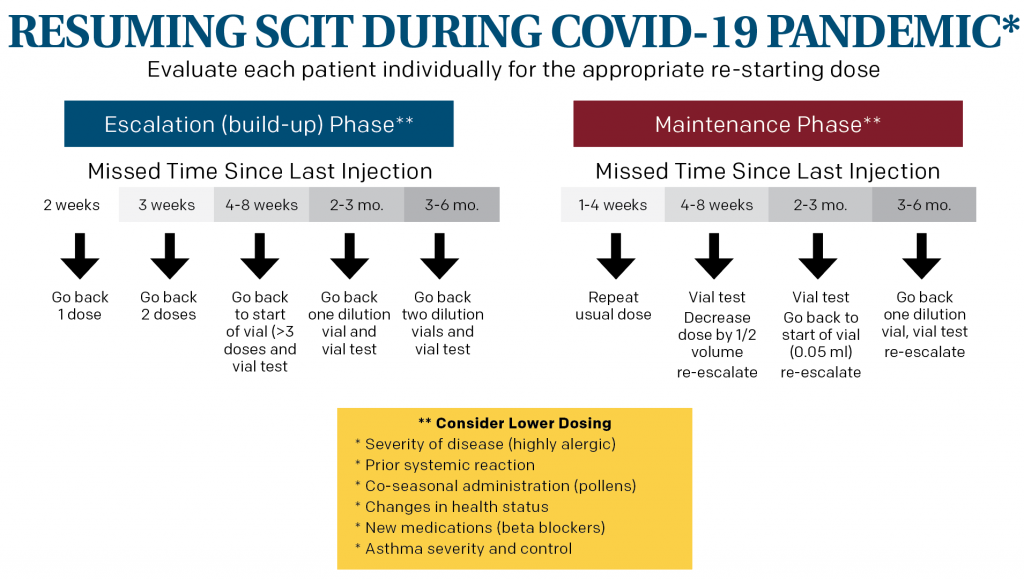
* This example is based on expert opinion as there is a lack of scientific data. Treatment of individual patients will require analysis of their medical condition and individual dosing for immunotherapy.

* This example is based on expert opinion as there is a lack of scientific data. Treatment of individual patients will require analysis of their medical condition and individual dosing for immunotherapy.

COVID-19 is transmitted through the aerosolization of viral particles, a fact that’s particularly concerning in allergy management. Use of pulmonary function testing, peak flow testing (PFT), and nebulized medications can promote the aerosolization of viral particles. Whenever possible, these procedures should be deferred or replaced with alternatives—for example, inhaled corticosteroids can be delivered by metered-dose inhalers rather than nebulizer, chest auscultation can be performed rather than PFT, and PFT may even be deferred until COVID-19 restrictions are eased. Frequent surface disinfection with 70% ethanol should be part of an allergy practice’s protocol.

A practice must also consider how it will manage patients and maintain social distancing as it reopens. Limiting additional family members, reducing shared materials such as magazines, pens, or check-in kiosks, and wider seat spacing in waiting areas are some issues to consider. 

Patients and staff should be regularly monitored for COVID-19 infection symptoms. Prescreening from the time of booking until the time of entry into the office should be considered. Screening questions should ask about exposure to COIVD-19, cough, shortness of breath, fever, and anosmia. Temperature monitoring can also be implemented prior to entry into the clinic. Patients displaying COVID-19 infection signs and symptoms should be referred to primary care for appropriate testing, when possible, rather than receiving their SCIT injections. All these precautions and more must be a significant part of the decision to reopen. 


Dr. Alpen Patel is the 2019-2020 president, Dr. Michael Platt is the treasurer, and Dr. Doug Dawson is the socioeconomic chair of the AAOA.

Pages: 1 2 | Single Page

Filed Under: Features Tagged With: coronavirus, COVID19, immunotherapy, patient care, patient safetyIssue: June 2020

You Might Also Like:

  • FDA Approves First Sublingual Allergy Immunotherapy Agents
  • Sublingual Immunotherapy a Potential Treatment for Allergic Rhinitis
  • Sublingual Immunotherapy (SLIT) Quality of Life Outcomes
  • Local Nasal Immunotherapy Safe, Effective for Allergic Rhinitis

The Triological SocietyENTtoday is a publication of The Triological Society.

Polls

Has experience as a patient influenced your professional development or demeanor?

View Results

Loading ... Loading ...
  • Polls Archive

Top Articles for Residents

  • A Resident’s View of AI in Otolaryngology
  • Call for Resident Bowl Questions
  • Resident Pearls: Pediatric Otolaryngologists Share Tips for Safer, Smarter Tonsillectomies
  • A Letter to My Younger Self: Making Deliberate Changes Can Help Improve the Sense of Belonging
  • ENTtoday Welcomes Resident Editorial Board Members
  • Popular this Week
  • Most Popular
  • Most Recent
    • The Path to Department Chair: Arriving and Thriving

    • How Audiologists and Researchers Are Shaping Military Hearing Health Practices

    • Office Laryngoscopy Is Not Aerosol Generating When Evaluated by Optical Particle Sizer

    • Rewriting the Rules of Rhinosinusitis

    • Top 10 LARY and LIO Articles of 2024

    • The Dramatic Rise in Tongue Tie and Lip Tie Treatment

    • Rating Laryngopharyngeal Reflux Severity: How Do Two Common Instruments Compare?

    • Is Middle Ear Pressure Affected by Continuous Positive Airway Pressure Use?

    • Otolaryngologists Are Still Debating the Effectiveness of Tongue Tie Treatment

    • Keeping Watch for Skin Cancers on the Head and Neck

    • Why So Loud? Rethinking the Volume of Our Everyday Experiences
    • How Audiologists and Researchers Are Shaping Military Hearing Health Practices
    • A Case for Endoscopic Surgery: How Personal Experience Influenced Pursuit of a New Skill
    • The Path to Department Chair: Arriving and Thriving
    • Rewriting the Rules of Rhinosinusitis

Follow Us

  • Contact Us
  • About Us
  • Advertise
  • The Triological Society
  • The Laryngoscope
  • Laryngoscope Investigative Otolaryngology
  • Privacy Policy
  • Terms of Use
  • Cookies

Wiley

Copyright © 2026 by John Wiley & Sons, Inc. All rights reserved, including rights for text and data mining and training of artificial technologies or similar technologies. ISSN 1559-4939